Case Studies
BRAND STRATEGY & VISUAL IDENTITY SYSTEMS
1) Brand Evolution Thoughout Organizational Change
Building indentity systems that hold an organization together while everything around it is changing
full rebrands
3
global regions
4
years of evolution
9+
colleagues impacted
1,100+
MY ROLE
Creative Director • Internal Brand Lead • Visual Identity Designer • Communications Strategist • Messaging Architect
THE CONTEXT
Over nearly a decade, an automotive financial services company went through three significant identity shifts. Each change reshaped not just the external brand, but the internal identity of the IT organization itself.
Each transition brought new leadership priorities, new business language, and new strategic direction. And each one required the internal IT organization to redefine how it presented itself, visually, culturally, and strategically, to 1, 100+ colleagues across four regions.
THE PROBLEM
Organizational change at this scale is disorienting by nature. Names change. Structures shift. Leadership priorities evolve. And without a cohesive identity to anchor to, communication becomes fragmented, different regions saying different things, teams losing the thread, colleagues unsure what the organization actually stands for in its new form.
The risk wasn't just visual inconsistency. It was cultural drift, the slow erosion of shared identity that happens when an organization changes faster than its people can make sense of it.
A rebrand isn't a logo swap. It's a chance to tell people who they are now, and why that matters.
Every transition was an opportunity. Not just to update the visuals, but to redefine the experience of the organization, to give people something to recognize, rally around, and feel part of during a period when a lot of other things felt uncertain.
WHAT WAS BUILT
For each organizational phase, a full internal identity system was developed from the ground up, not adapted from the previous one, but purpose-built for where the organization was headed.
Visual identity
Logos, color palettes, typography, and branded asset systems purpose-built for each phase
Messaging Frameworks
Strategy themes, taglines, and organizational narratives aligned to leadership direction
Templates and standards
Presentation systems, communication standards, and style guides deployed globally
Digital presence
Social Intranet design, digital communication visuals, and platform identity updates
Launch Campaigns
Internal campaign visuals and branded experiences supporting each transition moment
Events and Experiences
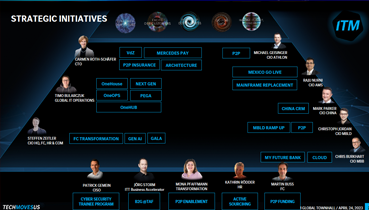
Town halls, leadership meetings, and team events branded to reinforce each new identity
WHAT HAPPENED
Each transition landed with clarity rather than confusion. Teams across regions could quickly orient to the new strategic direction while still feeling connected to a shared organizational identity. The visual language created continuity, a through-line that held even as the name and structure changed around it.
Over nine years and three full rebrands, the IT organization developed something rare: a recognizable internal brand with its own voice, its own look, and its own culture, one that could flex with each new business chapter without losing its footing.
Organizational change went from something abstract and unsettling to something people could see, understand, and feel part of. That's what a well-designed identity system can do.